Tutorials
Estimate Crochet Blanket Yardage from a Swatch
Estimate crochet blanket yarn with a weighed swatch, area calculations, per-color planning, border samples, practical reserves, and whole-skein conversions.
Crochet.Digital · · 11 min read
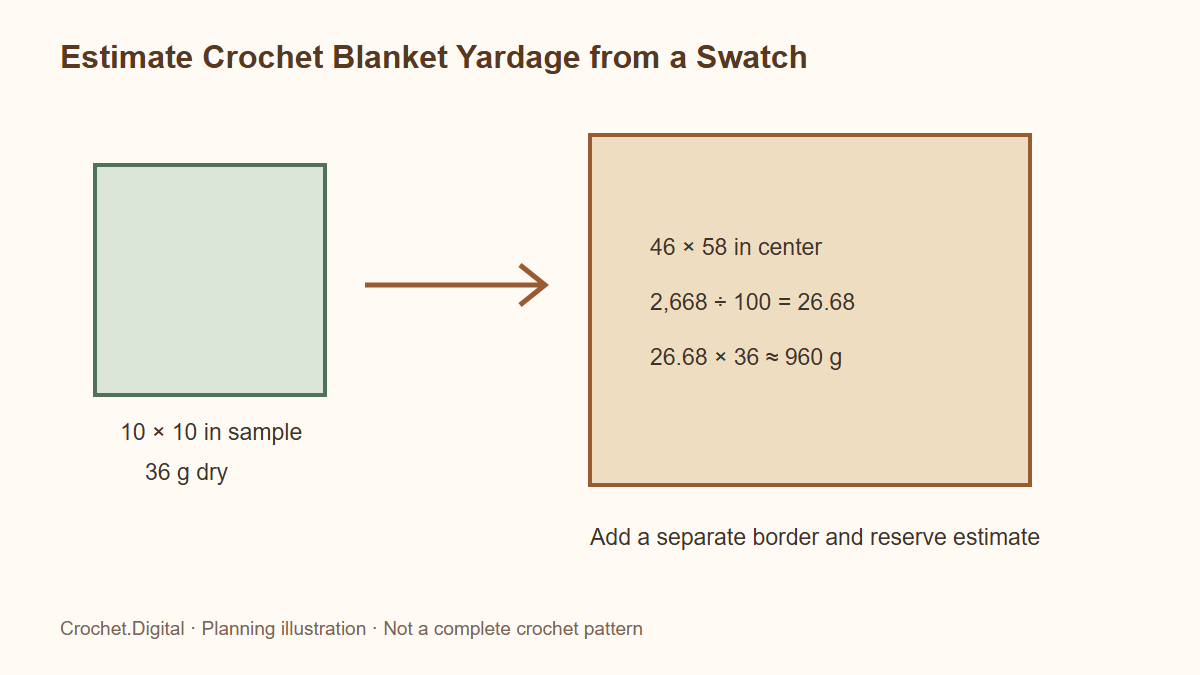
Estimating blanket yarn is a measurement problem with several manageable uncertainties. Blanket dimensions matter, but so do the stitch pattern, fabric density, color arrangement, border, and the length supplied in each ball. A generic chart can help compare project scales, yet it cannot promise the quantity for every combination of those choices. A sample made with the actual materials gives a much more relevant starting point.
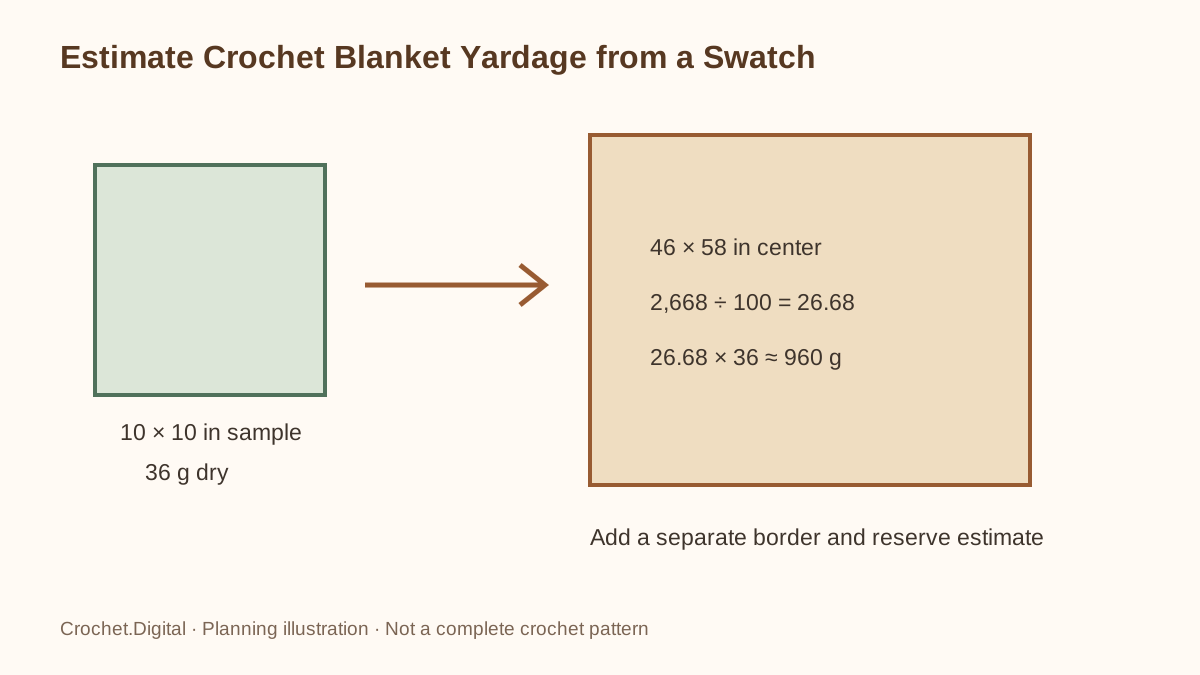 A weighed ten-inch sample is scaled by area to estimate central blanket yarn, with the border and uncertainty reserve kept separate.
This guide shows how to estimate yarn from a weighed sample and translate the result into whole balls. The examples use invented project measurements to demonstrate the arithmetic; they are not tested yarn requirements for a particular pattern. Keep the distinction between an estimate and a guarantee throughout the process. When a designer provides quantities for the exact size, yarn, and gauge you intend to use, that information is the better project-specific reference.
Collect the measurements before using a calculator
Record the target finished width and length, the planned border width, and the central stitch pattern. Write down the yarn's fiber composition, ball weight, and stated length per ball. Also note the hook used to make the sample. If the blanket includes several stitch textures, gather a representative sample for each substantial area rather than assuming all sections use yarn at the same rate.
A kitchen scale can be useful if it measures the sample reliably. Check its resolution and weigh a container separately if one is needed to keep the sample on the platform. A sample weighing only a few grams produces a less stable estimate than a larger representative sample. Increasing the sample size often improves the usefulness of the calculation more than adding decimal places to a very small measurement.
Make the sample representative of the central fabric
Use the actual stitch pattern, including its normal turning chains and any repeated texture. A single-crochet swatch cannot predict a dense bobble blanket accurately. Work enough repeats to include a meaningful interior area, and avoid evaluating a sample whose first row or outer edges dominate its shape. If the pattern alternates two kinds of rows, include enough complete pairs to reflect the finished fabric.
Prepare the sample using the intended care method and the yarn manufacturer's instructions. Weigh it when fully dry. Water retained in a recently washed sample increases the measured weight without representing additional yarn. Lay the fabric flat without stretching to measure its area, and record both dimensions. If its sides are slightly uneven, use consistent central measurements and note the uncertainty rather than pulling it into an artificially perfect square.
Decide which parts of the sample belong in the measurement
The sample's area and weight must refer to the same piece of fabric. If you measure only a central window but weigh a much larger swatch, the resulting yarn-per-area figure will be too high. Either measure and weigh the complete representative piece or use a method that genuinely isolates the material corresponding to the measured area. Long starting and finishing tails also contribute weight without increasing usable fabric area.
For a straightforward home estimate, measure the whole sample and keep its tails short enough to be insignificant relative to the sample's total weight, while leaving enough yarn to secure them. Do not cut a sample apart merely to obtain a cleaner number if that would make it unravel or prevent later reference. Record the method you used so the estimate remains understandable when you revisit it several weeks into the blanket.
Calculate the central-panel area first
Suppose the desired finished blanket measures 50 by 62 inches and will have a 2-inch border on all four sides. The central panel is therefore approximately 46 by 58 inches. Its area is 2,668 square inches. Notice that the border is subtracted twice from each dimension, because the edging appears on opposing sides. This calculation separates central fabric consumption from the often denser edging fabric.
For a 10-by-10-inch sample weighing 36 grams, the sample area is 100 square inches. Divide the planned central area by the sample area: 2,668 divided by 100 equals 26.68 sample areas. Multiply by the sample weight: 26.68 times 36 grams gives approximately 960.5 grams. Round this to a sensible working estimate rather than implying that the eventual blanket can be predicted to a fraction of a gram.
Convert estimated weight into length
Imagine the yarn label states 200 meters per 100 grams. That is 2 meters per gram. A central-panel estimate of 960.5 grams therefore represents about 1,921 meters. This conversion works because the sample and project use the same yarn. It is not a reliable way to convert the weight of one fiber or yarn construction into the length required of a substantially different replacement yarn.
To work in yards instead, use the label's yardage directly or convert the final meter estimate using one consistent conversion factor. Keep the original units visible throughout the notes. A frequent mistake is to divide a meter requirement by a ball quantity stated in yards, producing a quantity that looks plausible but is wrong. Label every number with grams, meters, yards, square inches, or square centimeters as appropriate.
Convert length into whole balls only at the right stage
If a ball supplies 200 meters and the central estimate is 1,921 meters, the arithmetic gives 9.605 balls. You cannot purchase a useful fraction of a standard ball, so the central panel alone would require at least ten full balls by that estimate. However, this is not yet the final purchase quantity. The border, joining method, color distribution, and uncertainty reserve still need to be considered.
Avoid rounding every intermediate calculation upward independently. Repeated early rounding can quietly create a much larger estimate than intended. Keep reasonable precision while calculating the central panel and individual components, add the appropriate reserve, then round each separately purchased color to whole balls. When colors are not interchangeable, the total number of grams across all colors does not tell you whether each color has enough material.
Estimate a border as its own fabric
A border's area can be calculated as finished area minus central-panel area. In this example, 50 times 62 equals 3,100 square inches. Subtracting 2,668 leaves 432 square inches occupied by the border. That area is useful, but it should be multiplied by a consumption measurement from the actual border fabric, not automatically by the central fabric's weight per area.
A short border sample can be easier to evaluate by linear length when the border has a consistent number of rounds. Work the planned edging along a measured sample edge, include a corner if corners are prominent, and weigh or measure the yarn consumed. Estimate the straight-edge requirement from the blanket's perimeter, then treat the corners as an additional uncertainty. Our guide to crochet blanket borders explains how corner shaping changes the fabric rather than simply adding decoration.
Handle stripes by actual row distribution
For equal-height stripes in the same stitch pattern and yarn, row counts provide a useful starting allocation. If one color occupies 40 percent of the central rows, assign approximately 40 percent of the central yarn estimate to it. This assumes that rows have similar stitch counts and consumption, which is reasonable for a rectangular panel but not for every shaped or corner-to-corner construction.
Include the yarn used in color transitions and tails. A blanket with many short stripes has a different finishing allowance from one with a few wide bands. If a scarce accent color appears only in narrow stripes, calculate its requirement separately and reserve it early. Do not rely on the combined total of all available yarn: an abundance of the main color cannot complete an accent row without changing the design.
Estimate motifs and joining yarn separately
For a square-motif blanket, weigh one complete motif after the intended finishing treatment, then multiply by the number required. If several motif designs or color arrangements use different amounts of each color, sample those variants separately. Count the actual color quantities in the proposed layout. A photograph showing an even mix can conceal a layout that requires substantially more of one motif arrangement than another.
Joining yarn needs its own allowance. A slip-stitch ridge, a single-crochet join, and a sewn seam do not necessarily use the same length along an edge. Make a small joined group to evaluate both dimensions and consumption. Do not include joining weight in the motif figure and then add it again as a separate component. Keep the worksheet organized as motif fabric, joining material, and final border, with each section counted exactly once.
Choose a reserve that matches the uncertainty
There is no universal percentage that guarantees every blanket will have enough yarn. A project closely matching a tested pattern in the specified yarn has a different uncertainty from a resized design using several dense textures. A reserve is a deliberate allowance for that uncertainty, not a claim that a fixed extra amount solves every shortage. Include the risk of changes in personal gauge over a long project.
For an illustrative estimate, adding 10 percent to a combined 2,200-meter requirement gives 2,420 meters. That demonstrates the calculation, not a mandatory reserve for all blankets. Increase or reconsider the allowance when the sample is small, the border is untested, or the yarn may be difficult to replace. Keep labels and purchasing information so any later search for matching yarn uses accurate fiber, color, and dye-lot details.
Check the estimate against project weight and practicality
A calculated yarn quantity also predicts approximate dry project weight when the same yarn is used throughout. Ask whether that weight suits the intended blanket. A large, dense cotton blanket can be inconvenient to move or dry even if there is enough yarn to finish it. This check may lead to a more open stitch, a smaller finished rectangle, or a different material before the main work begins.
The same reasoning helps compare two possible designs. If one sample uses noticeably more grams per square inch, it will generally create a heavier blanket of equal area in that yarn. That is useful planning information rather than a reason to declare one stitch superior. Consider the desired warmth, drape, opacity, texture, and washing routine alongside the yarn budget. The blanket planning guide brings those decisions into one project brief.
Recalculate from the first substantial section
Once a meaningful portion of the blanket is complete, compare actual progress with the estimate. Measure the completed area under relaxed conditions and weigh the remaining yarn or the work itself, as practical. Check that the fabric contains the intended stitch count before interpreting an unexpectedly high consumption figure. Extra stitches and an unintended texture can use more yarn while also changing the dimensions.
If the work is consistent, update the estimate using the larger real section. This is particularly helpful when the original sample was relatively small. Do not wait until the final ball is nearly gone. An early recalculation leaves options: obtaining more yarn, shortening by complete repeats, reducing border complexity, or adjusting later stripe distribution. Document the change so the final blanket remains deliberate rather than becoming a sequence of emergency substitutions.
Keep an honest yarn worksheet
A useful worksheet records inputs and assumptions, not only the final ball count. Include sample dimensions and dry weight, target central area, the resulting central estimate, border or joining estimates, each color's allocation, the chosen reserve, and the length supplied per ball. Add a line for the actual purchase quantity. This makes it possible to identify which assumption changed if the project later uses more or less yarn than expected.
For technical reference, consult the Craft Yarn Council's yarn-weight system and the manufacturer's label for the exact yarn. A broad yarn category is a starting vocabulary, while the sample supplies project-specific evidence. Save the completed worksheet with the true finished dimensions and leftover quantities. Those observations will be far more useful for the next blanket than a remembered claim that a throw always takes a certain number of balls. You can compare suitable downloadable designs in the pattern library before committing to the next large purchase.
Related guides
Keep reading
Tutorials
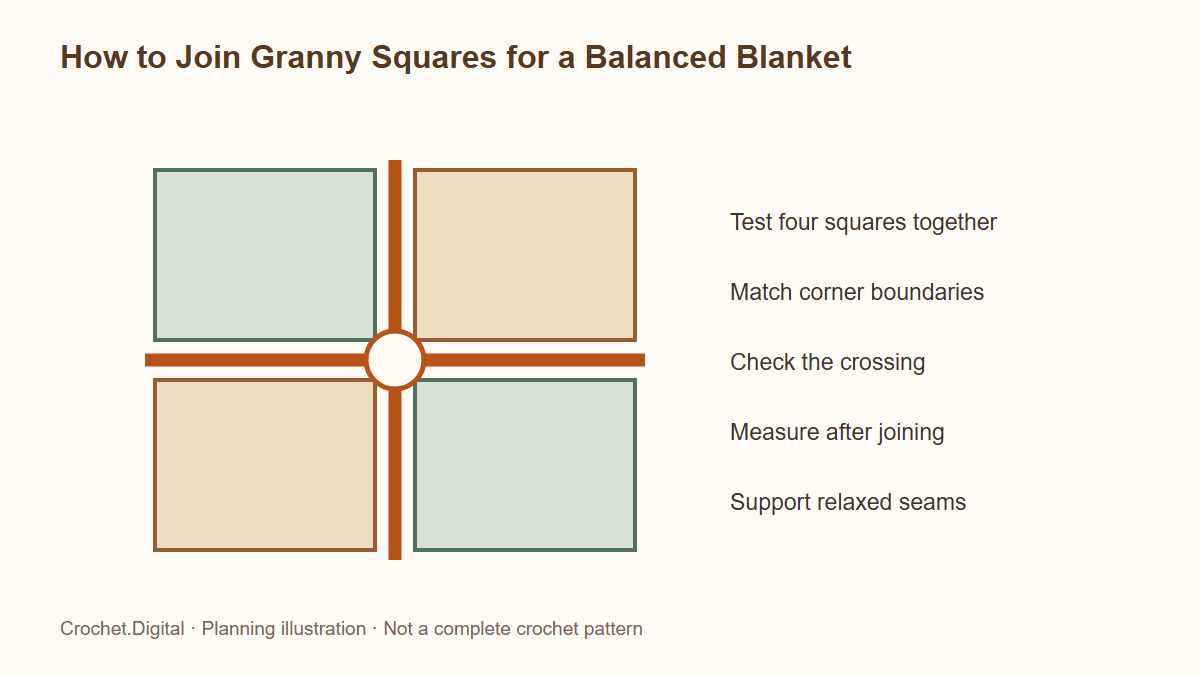
How to Join Granny Squares for a Balanced Blanket
Compare sewn and crocheted granny-square joins, align corners and stitch counts, test finished dimensions, and assemble a blanket without pulling its seams tight.
· 11 min read
Tutorials
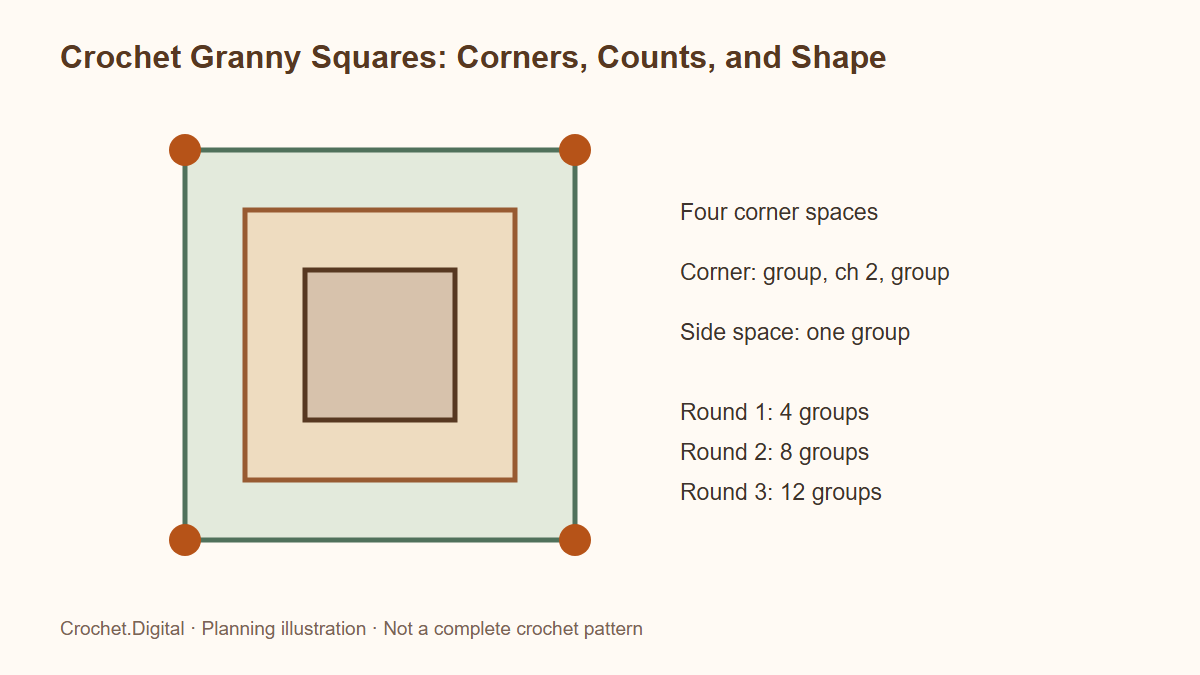
Crochet Granny Squares: Corners, Counts, and Shape
Understand a classic crochet granny square with clear corner placement, stitch-group counts, joining choices, color changes, and practical checks for flatness.
· 11 min read
Tutorials
How to Read Crochet Charts, Symbols, and Repeats
Follow a crochet chart by finding its key, working direction, insertion points, and repeat boundaries before checking the fabric.
· 12 min read