Tips
How to Substitute Yarn in a Crochet Pattern
Compare yarns for fabric and fit, then use simple yardage calculations to buy enough for each color in your crochet project.
Crochet.Digital · · 12 Min. Lesezeit
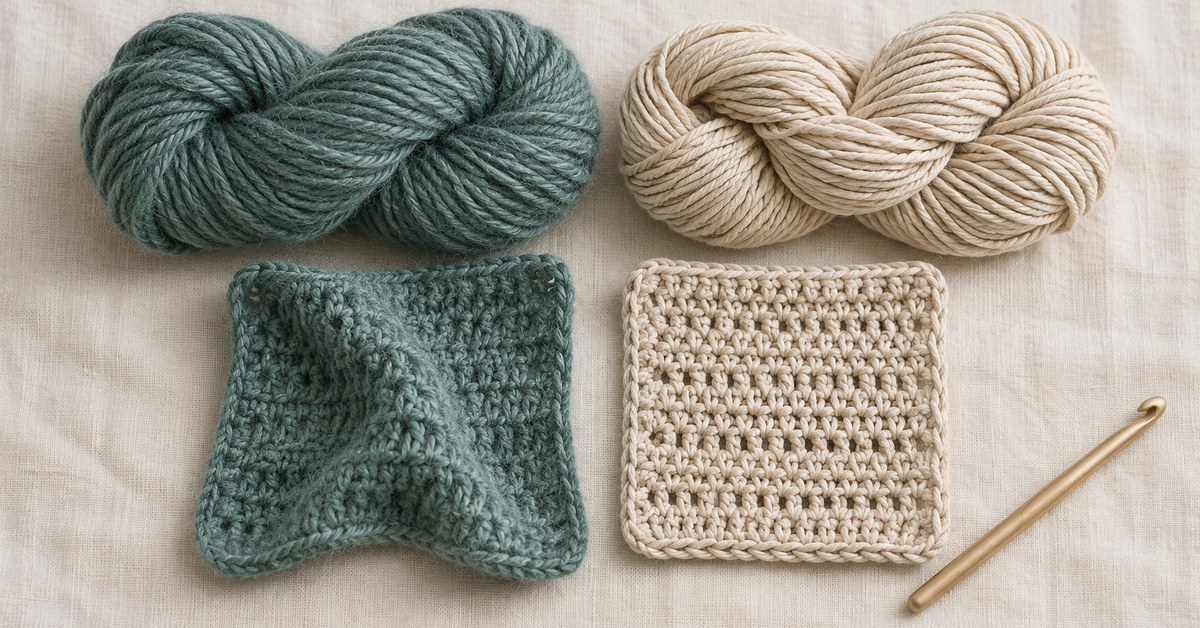
You can substitute yarn in a crochet pattern when the replacement gives you the right fabric at the pattern gauge and you can buy enough length. Start with the yarn weight category, then compare fiber, construction, and yards per ounce or meters per gram. Crochet a washed sample in the project stitch before buying a full project quantity. Once the fabric works, divide the yardage required for your size by the yardage in one replacement skein and round up. The number of skeins in the original pattern is only useful once you know how much yarn each skein contains.
A successful swap starts with the job the fabric has to do. A tote that needs to stay upright, a shawl that needs to fall in soft folds, and an amigurumi that needs to conceal its stuffing have different requirements. Two skeins with the same weight symbol can behave differently in all three projects.
Collect the information that the pattern actually gives you
Open the materials, gauge, and size sections of the pattern. Write down the recommended yarn name, weight category, fiber, length and weight per skein, hook size in millimeters, and the required yardage for your chosen size. Next, write down the gauge and its conditions. A target measured in blocked lace is different from a number measured in unwashed single crochet. Look for both stitch gauge and row gauge, or for a finished motif measurement if you are making a project from squares.
Some patterns list the yarn separately for each color. Preserve those amounts rather than adding everything together first. One stripe might take less than a skein and the background might need several. If the pattern only gives skein counts, multiply the number of skeins of each color by the length of the original skein. A pattern that says four balls of a yarn sold in 125-yard balls implies up to 500 yards for that color. The designer might have rounded up from a smaller tested amount, but 500 yards is a useful planning figure until you find an explicit yardage.
Check whether the pattern holds two strands together, alternates them, or changes yarns for a border. If a pattern works the body with two strands held together, a 200-yard path through the stitches uses about 200 yards from each strand, or 400 yards total across both. A pattern that already gives total yardage for a doubled fabric may have made this calculation for you. Read the material list and swatch notes together before doubling anything yourself.
Use yarn weight to narrow the search
Start in the same weight category as the recommended yarn. If the label uses US terminology, look for a weight symbol or check the manufacturer's description. The Craft Yarn Council standard yarn weight guide shows the commonly used categories and starting ranges. Those ranges help you choose a few candidates. The gauge in the project pattern is the target for the finished fabric.
A category covers a range. Two medium yarns can sit near opposite ends of that range. Texture makes the comparison trickier. A fuzzy strand may look thick because the halo spreads beyond its core. A densely twisted yarn may look slim even though it makes a heavy fabric. Compare actual strands in similar light if you have the original yarn. When shopping online, compare the weight symbol, fiber blend, and length per unit of weight before deciding which sample to buy.
One useful comparison is yards per ounce or meters per 100 grams. Suppose the original yarn contains 220 yards in a 100-gram skein. A substitute with 210 yards in 100 grams is closer on that one measure than one with 140 yards in 100 grams. Treat the figures as clues. Fiber density and construction affect length per unit of mass, so an airy wool and a dense cotton can have different lengths even when both make a usable fabric at the same stitch count.
Compare fiber, twist, and care before settling on a skein
For a fitted garment, consider how the fabric springs back after you stretch it. Many wool yarns have useful recovery, but a particular blend may behave differently. A cotton or linen yarn can give a cool, clean fabric and may hold a crease or grow under its own weight. An acrylic can be practical if the intended care is straightforward, yet the hand varies widely across products. Check what the pattern needs at the neckline, cuffs, and hem. These edges may need more recovery than the main fabric.
For stitch definition, compare the yarn's surface. A smoother, clearly plied yarn usually makes cables, post stitches, and carefully counted color changes easier to see. A soft halo can be attractive in open lace and may obscure detail in a small toy face. Chenille and other pile yarns can hide stitch boundaries. If your first project has frequent increases or color changes, use a practice swatch to learn where to place the hook before committing to the full project.
Check the care instructions on the substitute rather than carrying over the care routine from the pattern's sample. If you are making something that will be washed often, test the routine you actually expect to use. Crochet a small piece with all the colors you plan to combine and look for color transfer after washing. If you need the finished fabric to dry flat, check whether it is still pleasant to handle when it is fully dry. A yarn can feel quite different in the skein, while damp, and after drying.
Swatch for fit and fabric feel
Use the pattern's stitch, recommended hook, and intended technique for your first swatch. Work a sample big enough to measure away from the edges. Wash and dry it according to the project and replacement yarn. Then count both stitches and rows in the center. For a more detailed process and the measurement math, follow the crochet gauge swatch guide.
When your swatch has more stitches than the pattern over the same width, try a larger hook. When it has fewer, try a smaller one. Check the fabric again after each adjustment. If you only match gauge by using a hook that makes the fabric board-stiff, look for a different yarn. A substitute is useful when you can reproduce the dimensions while keeping the qualities the design needs. For a shawl, hang the dry swatch over your hand. For a bag, pull gently across it as it would be pulled when carrying weight. For an amigurumi, put a scrap of stuffing under the swatch and look at it in bright light.
Row gauge deserves special attention on patterns that place shaping by row count. A straight section that tells you to work until it measures 12 inches can often absorb a small row difference. A raglan or fitted sleeve that adds stitches at named rows has less room for adjustment. Work through the designer's construction notes and check how the affected pieces will meet. Matching the stitch count alone does not guarantee the neck, armhole, or sleeve length will sit where the designer intended.
Calculate replacement yarn by length
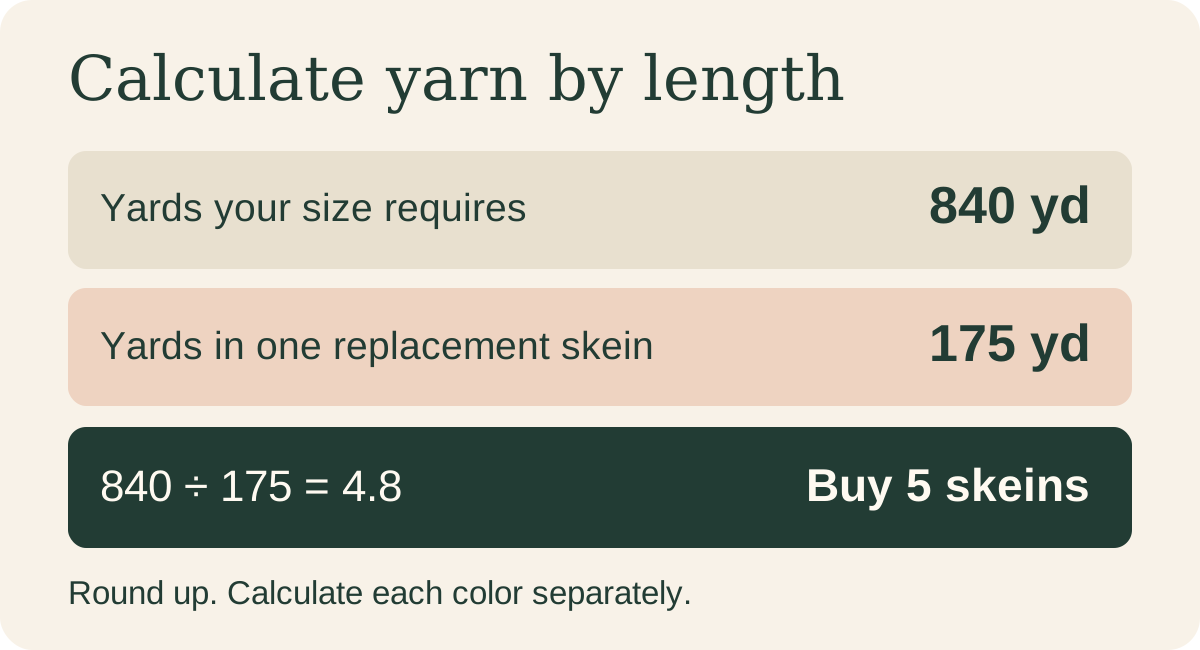
Pick one unit for the whole calculation. If the pattern calls for 840 yards and the replacement comes in 175-yard skeins, 840 divided by 175 equals 4.8. Round up to five skeins. If you expect to use another 80 yards for a larger collar or an extra length of sleeve, calculate again with 920 yards. That requires six skeins. When a pattern is written in yards and the label only lists meters, convert the required yardage to meters once and keep working in meters. One yard equals 0.9144 meters.
Calculate each color separately. For example, a blanket calls for 600 yards of the main color and 155 yards each of two accent colors. If the substitute provides 180 yards per skein, you need four main-color skeins and one skein of each accent, six total. Dividing the combined 910 yards by 180 also gives six after rounding in this particular example, but another color split could give a different total. If the main color requirement were 550 yards and the accents took 100 yards each, the combined calculation would say five, while the separate quantities still need six. You cannot spend unused accent-color yardage on the main-color field.
Decide on spare yarn based on the specific project. A swatch that will not be unraveled, added length, fringe, planned repairs, and a difficult-to-match dye lot are concrete reasons to buy extra. A project with multiple colors can leave plenty of spare yarn in one color and very little in another. If the store accepts returns on untouched skeins, check the policy before buying an extra one. That makes it easier to buy enough for the project while controlling waste.
Pick the substitute for the project, not just the label
A lightweight sweater
Put the washed swatch on a flat surface, measure it, then hold it at one corner to look at drape. Think about how much the full sweater will weigh. A dense yarn can drag a garment down even if a small swatch feels manageable. If the pattern includes ribbing or a worked-in neckline, test a strip of that fabric as well. Try stretching and releasing it a few times. A body fabric with lovely drape is only part of the decision if the neckline needs to recover.
A market bag or structured basket
Look at what the stitches do under load. Tight, stable stitches often help a bag retain its shape. Some cottons stretch with weight even when they feel firm in a sample. Make a small test strip long enough to clip or hold at both ends, stretch it gently, and see how it recovers. If the pattern uses a lining or reinforced base, remember that those parts contribute structure too. A softer yarn might work with a firm lining, while a different substitution would be needed for an unlined bag.
A toy or small amigurumi
Check fabric opacity and the size of the finished pieces. A thicker strand will generally produce a larger toy, which may also need more stuffing and different proportions for any sewn details. If the original pattern uses smooth yarn and you switch to a plush yarn, count increases and decreases with removable markers. Keep the stitch count and placement clear even when the pile hides the stitch tops. Treat accessories sized for the original toy as separate pieces to measure and adjust.
A wide blanket or modular motif project
Decide whether the finished width is fixed. For a blanket that must fit a particular bed, measure the blocked stitch repeat, calculate how many repeats fit across the intended width, and keep the pattern's edge stitches. For a motif blanket, make and wash a few motifs in the replacement yarn and join them using the pattern's method. Measure the joined section. A single square cannot show how a join changes the spacing across several squares.
When to change the plan
If the only available substitute is a different weight category, treat it as a design change. A pattern for a rectangle gives you more freedom than a shaped garment. You can sometimes recalculate the starting repeat and work to a physical measurement, then accept changes in drape and total yardage. For a fitted design or a colorwork chart that places details at exact stitches, the same change can move shaping and alter the visual scale. Choose a closer yarn if you want to follow those instructions without recalculating the pattern.
Two thin strands can be a workable substitute for one thick strand, but combinations vary. They can make a firmer fabric, show two colors, or separate when you insert your hook. Crochet the swatch with the strands held together as you will use them. If you use leftovers, measure or weigh each strand separately. One short ball can limit a long second ball. When replacing yarn from a limited dye lot, a planned stripe or contrasting border can make an available quantity more practical than a barely sufficient match.
If you are working from stash and the labels are gone, make a larger swatch, wash it, and estimate the yarn used with a scale that can measure small differences. For a rectangular project using the same stitch throughout, the dry sample's weight per square inch can give a rough total weight estimate. This works best with the same yarn and gauge throughout. A heavy border, openwork mixed with solid stitches, or fringe changes the result. Keep a reserve if there is no way to get more.
Write a substitution note you can use again
Record the original pattern and size, the replacement yarn and dye lot, the hook in millimeters, the washed stitch and row gauge, the yardage planned, and how much yarn you actually used. Add a sentence about the finished fabric. For example, “This cotton gives a crisp stitch and a firm edge, but the finished panel has very little stretch.” A useful note explains why the same yarn might be a great choice for a basket and a less useful one for a close-fitting cuff.
Use this order when you are ready to shop: check the pattern's requirements, find a similar yarn category, compare fiber and construction, test the washed fabric, then calculate yards per color. If you are still choosing what to make, the guide to choosing a crochet pattern can help you find a project whose fabric and yardage work with the yarn you already have.
Weiterlesen
Tips
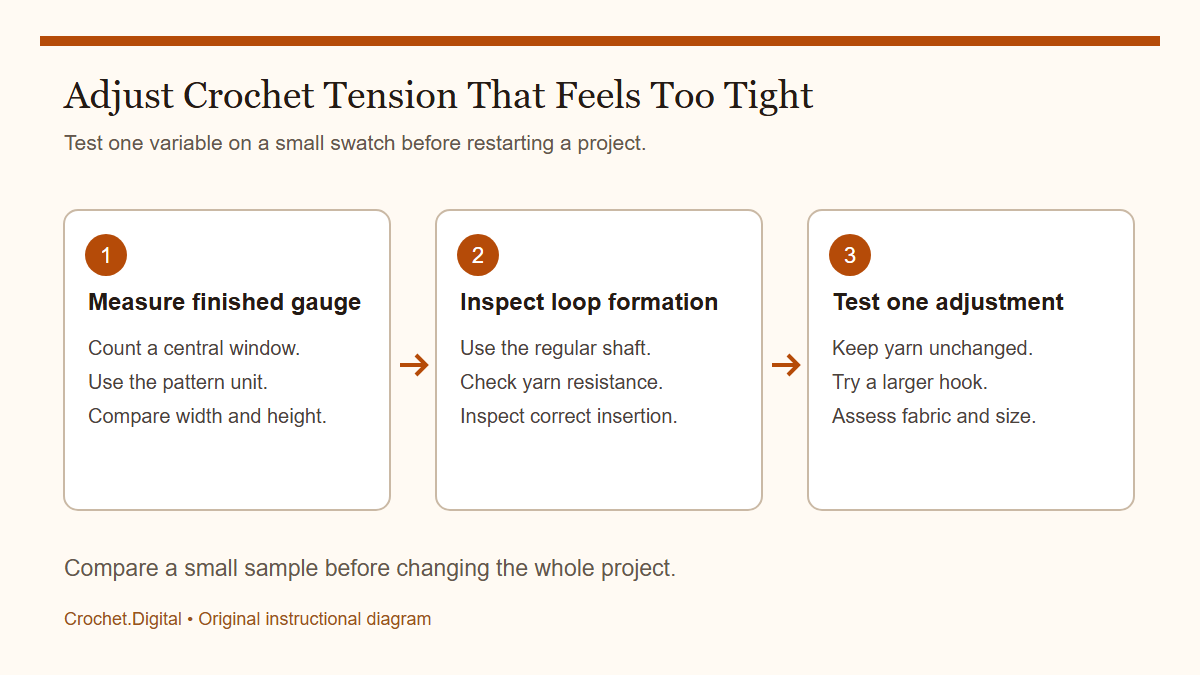
Crochet Tension Too Tight: A Practical Gauge Check
Diagnose too-tight crochet with finished gauge, loop formation, yarn resistance, and controlled hook-size comparisons.
· 11 Min. Lesezeit
Tips
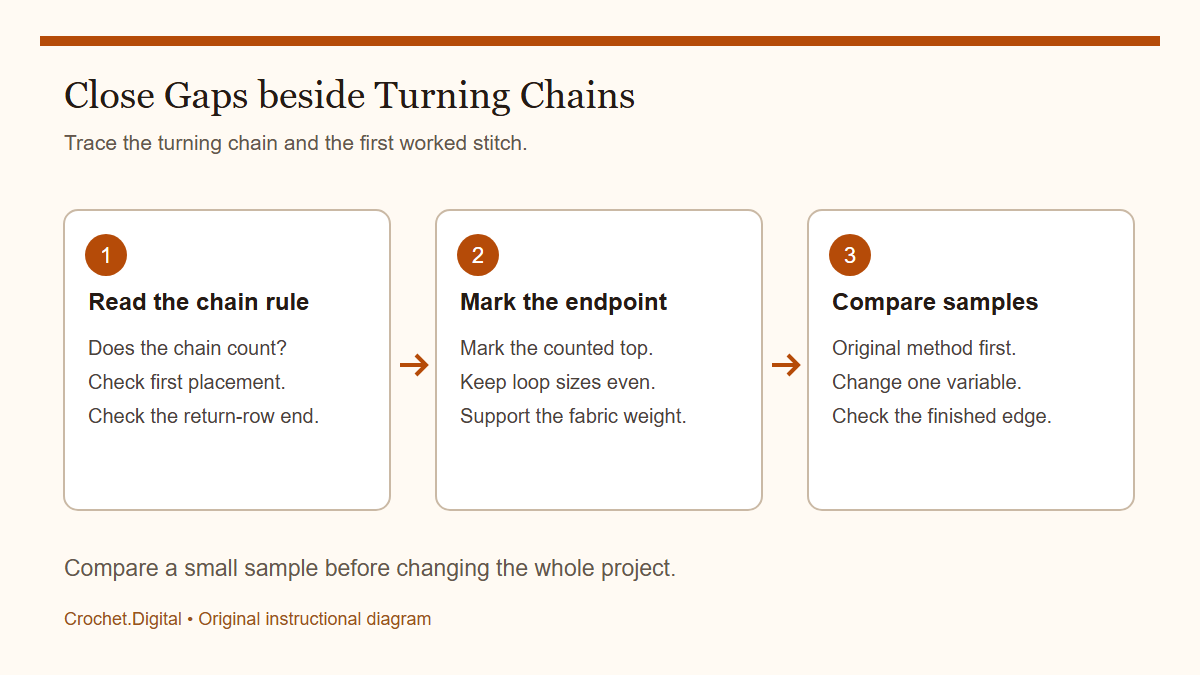
Crochet Turning-Chain Gaps: What to Check First
Check counts, chain height, and endpoint placement before changing the starting method at the edge of a crochet row.
· 11 Min. Lesezeit
Tips
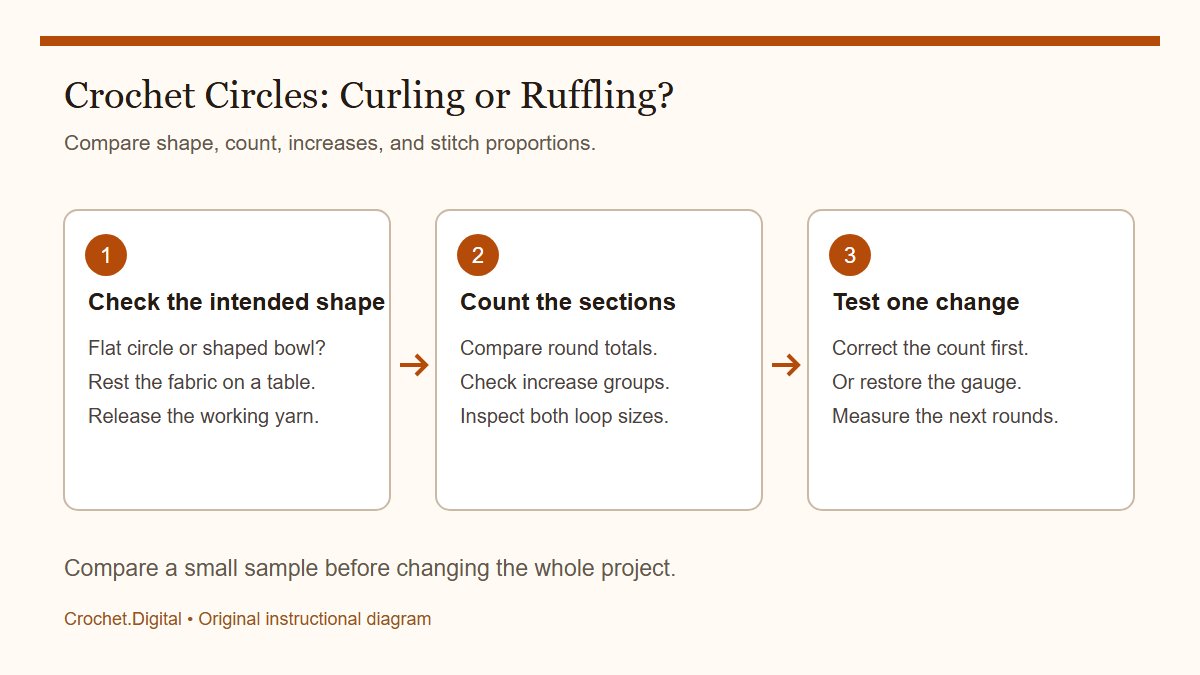
Crochet Circle Curling or Ruffling: Diagnose the Shape
Compare stitch counts, increase placement, and resting measurements to diagnose a curling or ruffled crochet circle.
· 11 Min. Lesezeit