Beginner
US vs UK Crochet Terms: Translate a Pattern Correctly
Match US and UK stitch names to the same physical movements while preserving every count, location, and turning-chain instruction.
Crochet.Digital · · 12 Min. Lesezeit
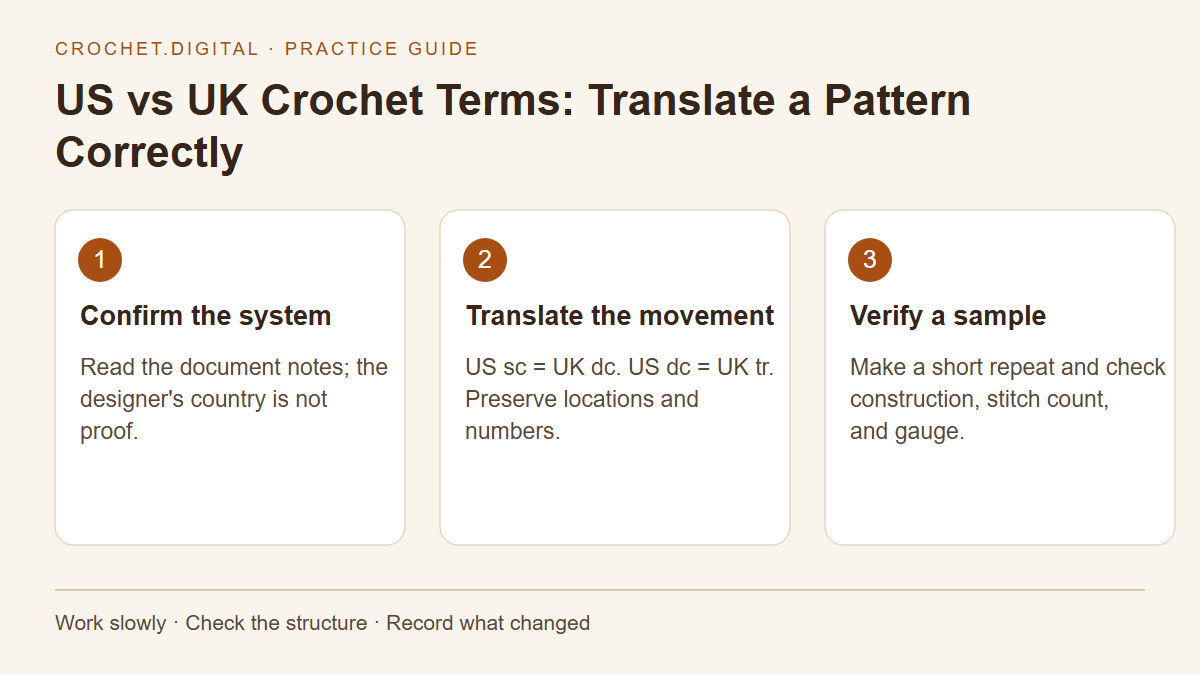
US and UK crochet terminology describe many of the same physical stitches with different names. A US single crochet is called a double crochet in UK terminology. A US double crochet is a UK treble. The fabric does not change when the name changes, but a project can change dramatically if you work the wrong stitch. The safest approach is to identify the pattern's terminology before starting, translate the names consistently, and verify one short sample rather than guessing from the finished photograph.
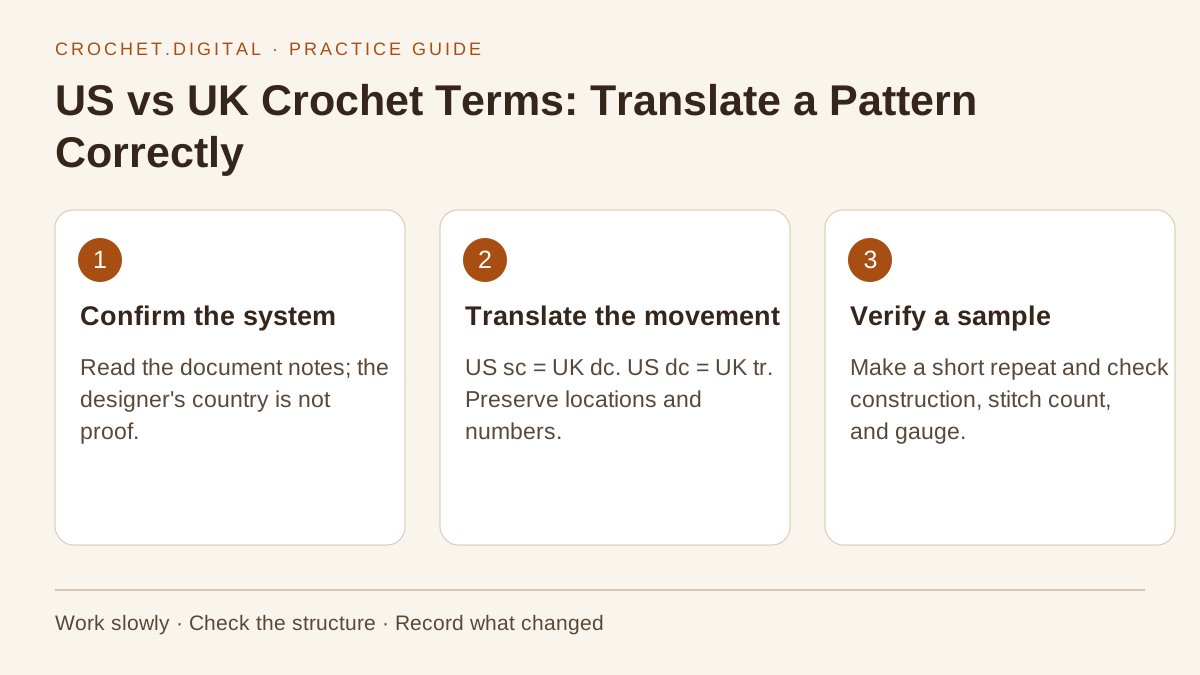 US vs UK Crochet Terms: Translate a Pattern Correctly: a practical sequence to use beside your project.
Identify the system before translating individual words
Look near the beginning of the pattern for an explicit terminology statement. Designers often place it beside the skill level, abbreviations, or materials list. A website's country, a designer's accent, or the currency used to sell a PDF does not establish the crochet language inside it. A UK designer can write in US terminology, and an American publisher can provide a UK edition. Check the actual document you downloaded, including its title page and any notes attached to charts.
If there is no clear statement, inspect the stitch definitions. An instruction that begins by inserting the hook, drawing up a loop, and pulling through two loops describes the physical stitch called US single crochet. An instruction that starts with a yarn over and finishes with two successive pull-through-two movements describes US double crochet. A definition can help identify the system, but if the pattern is still ambiguous, ask the designer. A clear answer is more efficient than remaking a large panel.
Use a small conversion table beside the pattern
| US term | UK term | Typical abbreviation pair |
|---|---|---|
| Chain | Chain | ch / ch |
| Slip stitch | Slip stitch | sl st / ss or sl st |
| Single crochet | Double crochet | sc / dc |
| Half double crochet | Half treble crochet | hdc / htr |
| Double crochet | Treble crochet | dc / tr |
| Treble crochet | Double treble crochet | tr / dtr |
| Double treble crochet | Triple treble crochet | dtr / trtr |
This table is a reference for ordinary stitches, not permission to replace a designer's special-stitch definition. Extended stitches, linked stitches, and named combinations can have additional instructions that matter as much as the regional name. Preserve those definitions when making a working translation. The goal is to identify the same movement and placement, not merely substitute letters in a sentence until it looks familiar.
Connect each name to its physical construction
For the stitch called US single crochet or UK double crochet, insert the hook into the specified location, yarn over, and draw up a loop. There are now two loops on the hook. Yarn over and draw through both. For US half double crochet or UK half treble, start with a yarn over, insert the hook, and draw up a loop; yarn over and draw through the three loops together. Keep the working loops on the hook's shaft rather than squeezing them onto the narrow throat.
For US double crochet or UK treble, begin with a yarn over, insert the hook, and draw up a loop. Yarn over and draw through two loops, then yarn over and draw through the remaining two. For US treble or UK double treble, start with two yarn overs, draw up a loop, and complete three successive pull-through-two movements. Understanding that sequence lets you check a translation with your hands instead of relying entirely on a printed name.
Do not convert chain counts just because stitch names change
A terminology translation normally leaves the construction numbers intact. If a UK pattern tells you to work twenty UK trebles, the corresponding US instruction is twenty double crochet stitches. You do not double or halve the count. If the pattern asks for a chain-three space, it is still a chain-three space after converting the stitch names. The number describes the structure, while the regional stitch word identifies the movement used to make it.
The same applies to repeats and shaping. A group of three UK trebles in one space becomes three US double crochet stitches in that space, not a different group size. Skipped stitches remain skipped stitches. Row numbers remain row numbers. If a converted version seems to require a different count, inspect the translation for a lost phrase, an accidentally translated abbreviation within another word, or an incorrect interpretation of the turning chain.
Keep the pattern's turning-chain convention
The usual height of a stitch can help you recognize a possible mismatch, but a turning-chain count is not conclusive proof of a terminology system. Designers use different edge treatments. A chain may count as the first stitch, remain uncounted, or be replaced by a standing or chainless starting stitch. Translating US and UK stitch names does not change any of those decisions. Follow the notes describing whether to work into the first stitch and whether to work into the top of the previous turning chain.
For a translated practice row, mark the first and last counted stitch. If the turning chain counts, one of those markers may belong in the top chain. If it does not count, the marker belongs in the first ordinary stitch instead. This physical marker makes the edge rule visible while your attention is occupied by unfamiliar terminology. A correct stitch name can still produce an incorrect width when the starting or ending location is misunderstood.
Watch the abbreviations inside increases and decreases
An increase often says to make more than one stitch in the same location. The number of stitches remains unchanged in translation, but their names change. A UK instruction for two dc in the next stitch becomes two US sc in the next stitch. The same regional relationship applies inside a decrease abbreviation. UK dc2tog describes the stitch family called US sc2tog, not US dc2tog. Read the whole abbreviation as a named technique rather than translating only its first two letters and forgetting its context.
Special decreases may have a method chosen for appearance, such as an invisible decrease in dense toy fabric. Translate the stitch vocabulary while preserving the insertion path the designer specifies. A decrease made through particular loops is not automatically interchangeable with an ordinary decrease worked through both loops. When the pattern gives a separate explanation, keep that explanation beside your converted shorthand until the movement becomes familiar.
Recognize terms that stay the same but have different abbreviations
Chain and slip stitch are broadly recognizable across both systems, yet their abbreviations can vary. A designer may write slip stitch as sl st, ss, or another locally defined form. Yarn over may appear as yo or yoh. The physical action is not changing merely because the shorthand is longer. Read the abbreviation key rather than assuming an unfamiliar pair of letters signals a new stitch you have not learned.
Words such as stitch, space, round, repeat, front loop, and back loop usually describe the same location or direction. However, the way a pattern abbreviates them is still a publishing choice. Keep a short list of the terms that actually occur in your project. It is more useful to remember that this particular pattern uses ss for slip stitch and htr for UK half treble than to keep a much longer list of abbreviations you will never encounter in the document.
Separate terminology from yarn and hook sizing
A pattern can use UK stitch names and still give a hook size in millimeters. It can use US stitch names and list a yarn described as DK, aran, or fingering. Do not convert the yarn category solely because you converted the stitches. Identify the actual yarn, fiber, meterage or yardage, and the gauge required by the pattern. Regional yarn descriptions can overlap imperfectly, and two yarns sold under the same category can produce different fabrics.
Millimeter hook measurements provide a useful starting point when letter and number labels are unfamiliar. Still, matching the stamped hook size does not guarantee matching the designer's gauge. Work the specified stitch pattern in a sample, treat it as the finished project will be treated, and measure it using the pattern's stated unit. Terminology conversion tells you which stitches to make; gauge checking tells you how large your version of those stitches becomes.
Convert a short section on paper before starting a project
Take this UK-style practice instruction: “Ch 1, turn, dc in each of the next 12 sts.” With an uncounted turning chain, the US working version is “Chain one, turn, single crochet in each of the next twelve stitches.” The resulting row still contains twelve counted stitches. Write both versions on separate lines. Point to the part that changed and the parts that did not. This makes the conversion rule concrete without bringing in shaping or a complicated repeat.
For a second example, “3 tr in next ch-2 sp” in UK terminology becomes “3 dc in the next chain-two space” in US terminology. All three stitches go into the same opening. The chain-two space is not converted into a chain-three space, and the three-stitch group is not distributed across three different openings. A reliable translation preserves every location and number while changing only the terms that refer to the physical stitch family.
Read charts through their own key
A chart can reduce the amount of regional wording you need to translate, but it does not remove the need to read the key. Symbols represent particular stitches, and the key may name those stitches using the pattern's terminology system. A tall symbol with a bar can be labeled UK treble or US double crochet while describing the same physical stitch. Read one symbol definition and connect it to the movement before interpreting the rest of the chart.
Also confirm the direction of working, the starting point, and the treatment of joins or turning chains. A chart does not guarantee that every circle is a chain stitch or that every dot has the same meaning in every publication. Designers can add symbols for special stitches or non-stitch information. If a chart and its written directions appear to disagree after translation, compare one small repeat and ask the designer for clarification rather than choosing whichever version is easier to crochet.
Avoid blind search-and-replace conversion
Automatic replacement can corrupt a pattern if it changes one abbreviation inside another or translates a term twice. For example, replacing dc with sc everywhere and then replacing tr with dc may seem logical in one direction, but a poorly ordered conversion can alter text that was already converted. Longer abbreviations such as dc2tog, FPdc, or dtr also require careful handling. Plain text replacement does not understand which letters are part of a stitch name and which belong to a URL, a title, or an ordinary word.
If you create a personal working copy, convert one instruction block at a time and keep the original alongside it. Highlight translated stitch terms, then check the count equation for the row. Mark the terminology prominently on the first page so you do not return to the project later and translate it a second time. Do not remove the designer's attribution or redistribute the converted pattern without permission; a personal aid does not change the rights attached to the original document.
Diagnose a fabric that looks unexpectedly tall or dense
If a translated sample has the right stitch count but is much taller than expected, a stitch-family mismatch is one possibility. Compare the actual construction of one stitch with the pattern's definition. Check the number of initial yarn overs and the number of finishing pull-through stages. Then inspect gauge, hook size, yarn choice, and measurement method. Terminology is not the only reason two samples differ, so change one possible cause at a time instead of immediately rewriting all the counts.
Once you confirm the intended movement, unravel the incorrect sample and remake a few rows. Do not try to compensate for a wrongly translated stitch by using an extreme hook size. That may alter the stitch width while leaving a different texture, drape, and row height. The aim is to produce the specified structure first. Only after the structure is correct should you use a gauge swatch to make ordinary tool and tension adjustments.
Keep one terminology system in your project notes
At the top of your notes, record the original system and the system you are using to work. For example, write “Pattern is UK; my notes use US.” Add a small conversion table containing only the stitch families in that project. Record any special-stitch definitions in full rather than giving them an improvised familiar name. This prevents a project diary from becoming a mixture of partly translated instructions that is difficult to restart after a break.
When looking up help, include the terminology system in your search or question. Asking how to make a UK treble and asking how to make a US treble lead to different movements. If you send a question to the designer, quote only the short relevant instruction and explain which stitch construction you attempted. Clear terminology makes the answer more useful and lets both of you discuss the fabric rather than discover halfway through that the same word meant different things.
Keep learning with your next practice session
Decode abbreviations and repeats. Keep the turning-chain convention. Read chart keys and directions. When you are ready to use these skills in a project, browse the independent crochet and knitting PDF patterns and read the materials, sizing, and skill notes before choosing.
Reference: The Craft Yarn Council standards provide a useful reference for checking the terminology and conventions used in a pattern. The instructions and practice examples in this guide use US crochet terminology unless stated otherwise.
Related guides
Weiterlesen
Beginner
How to Make a Slip Knot for Crochet
Make an adjustable starting loop, identify the working yarn and tail, and move from the knot into your first counted chains.
· 12 Min. Lesezeit
Beginner
How to Read Crochet Abbreviations and Pattern Repeats
Decode crochet instructions by separating the stitch, its location, and the number of repeats, then checking the finished count.
· 11 Min. Lesezeit
Beginner
Crochet Tools for Beginners: A Practical Starter Kit
Build a small crochet kit around a readable yarn, a comfortable hook, and simple tools that help you see and count your work.
· 12 Min. Lesezeit